






On Being Direct & Being Nice
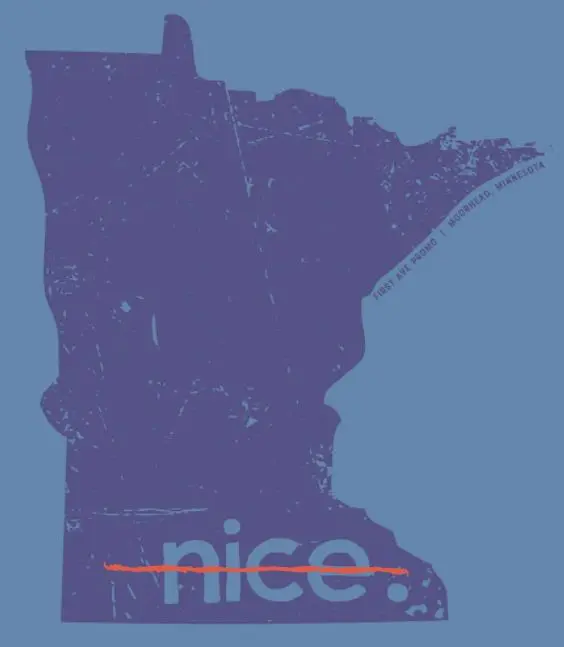
If being indirect is your way of being nice, keep in mind Archimedes and this mathematical principle: The shortest distance between two points is a straight line.
Let’s get to the point —
Mathematically speaking,
Straight lines always win.
I come from Minnesota. Land of 10,000 lakes and something called Minnesota Nice.
Thanks to Wikipedia, we even have a succinct definition of what Minnesota Nice is: Minnesota nice is a cultural stereotype applied to the behavior of people from Minnesota, implying residents are unusually courteous, reserved, mild-mannered, and passive-aggressive.
Having grown up in Minnesota — I know first hand what Minnesota Nice is. Having left for several years and observed and learned a wide variety of other cultural behaviors — I now see that some simple geometry is just the ticket for circumventing passive-aggressive (and not so nice) behavior.
Why do we do this?
Occasionally clients I work with will get hung up on the “why” behind a behavior — and that’s where I point out that my work as a coach is not that of a therapist. While discovering and uncovering why is fascinating, my job is to help how to shift behavior. To straighten up and fly right.
There are myriads of reasons as to why we as a group tend toward this behavior — and if we were at a cocktail party or sitting at a campfire, I’d be happy to riff on some ideas.
But back to that straight line business — More often than not, overly polite and passive-aggressive behavior is the avoidance of a problem. It’s going around the lake rather than crossing it in a canoe.
Clear, compassionate communication takes a balance of courage and courtesy.
Mathematically speaking, it means rather than circumnavigating an issue you, use a straight line.
When you have an issue with a coworker, and you are tempted to talk about them or the problem to another person:
Stop.
Consider: You are going around the problem.
I get that people need sounding boards before heading into a tough conversation. I want people going forward to consider the impact of those conversations — What are you really accomplishing?
Are you venting? Then make sure the person with whom you are venting is going to keep that in confidence.
Are you seeking an ally in the situation? If so, realize you are placing that third party in a precarious position — to choose sides. And in so doing, you may be making the ‘war’ worse.
This is where having/hiring a coach is important. A coach is a confidential, non-partisan listener who will guide you toward a first-hand conversation with the person or people with whom you are in conflict. Think of a coach as your CCO (Chief Communication Officer.) A good coach can roleplay with you, so you practice being direct in a safe environment. Or they may encourage you to spend more time with yourself and perhaps find the answers within your own body. Either way — you are taking the middle folx out of the picture.
The outcome is you have dealt with two things head-on. First, by utilizing a coach or trusted advisor, you are accepting responsibility for your behavior, rather than dragging others, innocent bystanders, if you will, into the fray.
Second, you are unlearning and relearning new behaviors that, in the end, will be far more efficient, effective, and emotionally intelligent.
The circuitous route, often mistaken as a courtesy, will become a straight line that helps you get literally and figuratively to the heart of the matter.
Now that’s what I call nice.
This article originally appeared on Medium.
Image credit is a collaboration of Canva/Catherine Glynn/First Avenue Creative.